

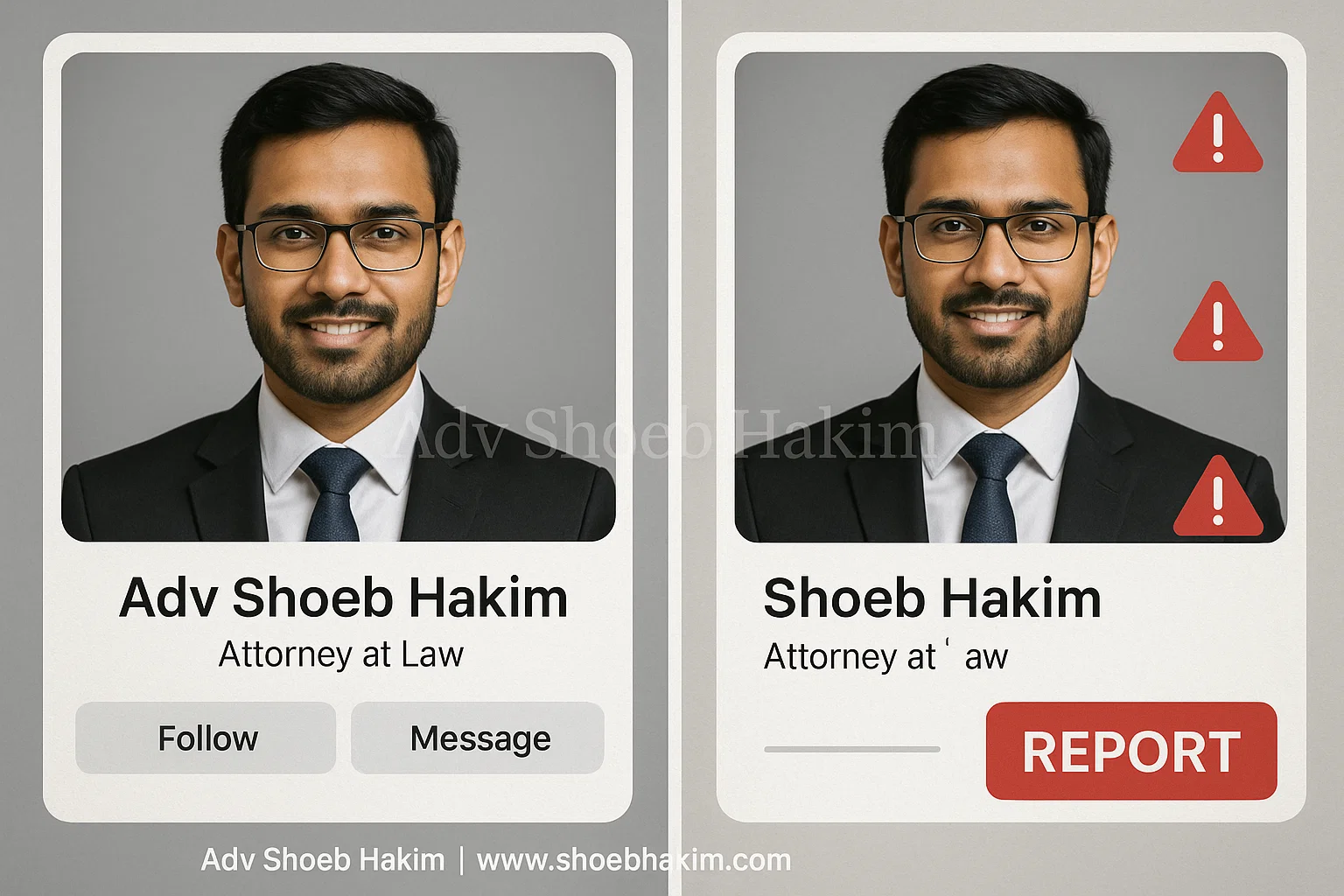
Fake Profiles Impersonation – Legal Guide
Why Adv Shoeb Hakim Considers This Article a Vital Read
Fake profiles impersonation is not merely a social media nuisance; it is a serious cybercrime with devastating financial, reputational, and emotional consequences. Such impersonation can lead to identity theft, phishing scams, and profound personal harassment.
This legal guide provides a definitive framework for Indian citizens to identify, report, and initiate legal action against perpetrators. Understanding the intersection of platform policies and the stringent provisions of the Information Technology Act, 2000, is crucial for anyone seeking to protect their digital identity and hold offenders accountable.
The Legal Anatomy of a Fake Profile: Understanding the Offence

From a legal standpoint, creating a fake profile for impersonation constitutes a series of criminal acts under Indian law. The primary statute governing such activities is the Information Technology Act, 2000.
The act of impersonation typically violates:
Section 66D of the IT Act: Punishment for cheating by personation by using computer resource. This section prescribes imprisonment for up to three years and a fine.
Section 66C of the IT Act: Punishment for identity theft. This involves fraudulently using another person’s electronic signature, password, or any other unique identification feature.
Furthermore, depending on the actions taken using the fake profile, other sections of the Bharatiya Nyaya Sanhita (BNS), 2023, such as those related to criminal intimidation, defamation, or cheating, may also be invoked.
Common Signs of a Fake Profile: A Forensic Checklist
Vigilance is the first line of defense. Adv Shoeb Hakim advises that the presence of multiple red flags strongly indicates a fake profile.
Low-Quality or Stolen Profile Pictures: Use reverse image search tools like Google Images to verify if the profile picture is a stock photo or stolen from a real person’s account.
Sparse or Inconsistent Information: The profile lacks a coherent bio, has very few posts, or the details provided are contradictory.
Generic or Algorithmic Usernames: Usernames that are a random string of numbers and letters (e.g., ‘user_3847592’) are often automatically generated by bots.
Unsolicited and Suspicious Messaging: The account initiates contact with requests for money, phishing links, or overly personal questions.
Low Follower-to-Engagement Ratio: A high number of followers with little to no genuine comments, likes, or shares on their posts suggests purchased or fake followers.
The Legal Dangers of Fake Profiles and Impersonation
The creation and use of fake profiles is a gateway to more severe crimes. The legal consequences for victims can be severe.
Scamming and Phishing: Impersonators can trick your friends and family into sending money or revealing sensitive information, leading to financial fraud.
Identity Theft: As defined under Section 66C of the IT Act, this can result in long-term damage to your credit and reputation.
Cyber Harassment and Defamation: Fake profiles are commonly used to spread false information, damaging your personal and professional standing.
Corporate Espionage and Brand Impersonation: Businesses are also targeted, with fake profiles used to deceive customers or damage brand equity.
How to Collect Digital Evidence for a Legal Case
If you decide to pursue legal action, preserving digital evidence is critical. The standards for electronic evidence are outlined in the Bharatiya Sakshya Adhiniyam (BSA), 2023.
Take Screenshots: Capture full-screen images of the entire fake profile, including the URL, profile picture, bio, and all posts/messages.
Record a Video: Use screen recording software to create a video navigating through the fake profile, demonstrating it is a live, functional account.
Preserve Metadata: Ensure the screenshots and videos include timestamps and URLs.
Document the Chain of Events: Maintain a detailed log of when you discovered the profile, what actions you took, and all communications related to it.
Obtain a Forensic Report: For a strong case, engage a digital forensics expert to create a certified hash value of your evidence, ensuring its integrity for court, as emphasized in the precedent set by Arjun Panditrao Khotkar vs. Kailash Kushanrao Gorantyal (2020) regarding the admissibility of electronic evidence.
Step-by-Step Guide to Reporting Fake Profiles
Reporting on Facebook
Navigate to the fake profile.
Click the three dots (…) under the cover photo.
Select “Find support or report profile”.
Choose “Pretending to be someone” and follow the on-screen instructions, specifying if they are impersonating you or someone you know.
Reporting on Instagram
Go to the impersonating profile.
Tap the three dots (…) in the top right.
Select “Report”.
Choose “Report account” > “It’s pretending to be someone else”.
Select the appropriate option (you, someone you know, or a celebrity).
Reporting on X (formerly Twitter)
Visit the profile you wish to report.
Click the three dots (•••) on their profile page.
Select “Report”.
Follow the prompts and select “It’s pretending to be me or someone else”.
Practical Checklist: Legal Action Against an Impersonator
If you are a victim of fake profiles impersonation, Adv Shoeb Hakim recommends this 5-step legal action plan:
Report to the Platform: Immediately report the profile using the official channels on Facebook, Instagram, or X to have it taken down.
File a Cyber Crime Complaint: Lodge a formal complaint on the National Cyber Crime Reporting Portal (https://cybercrime.gov.in). This is a crucial official record.
Register an FIR: Visit your local police station to file a First Information Report (FIR) under relevant sections of the IT Act (Sections 66C, 66D) and the BNS, 2023.
Send a Legal Notice: Through an advocate, send a legal notice to the platform and the unknown perpetrator, demanding the removal of the content and claiming damages for defamation and harassment.
Secure Your Digital Presence: Change your passwords, enable two-factor authentication, and audit your privacy settings on all social media accounts.
Frequently Asked Questions (FAQs)
What is the punishment for creating a fake profile in India?
Creating a fake profile to impersonate someone is primarily punishable under Section 66D of the IT Act, 2000, with imprisonment of up to three years and a fine. Additional charges under the BNS for defamation or cheating can also apply.
Can I sue someone for impersonating me on social media?
Yes, you can initiate both civil and criminal proceedings. You can file a criminal case under the IT Act and also sue for damages in a civil court for defamation, mental harassment, and loss of reputation.
The police are not taking my complaint about a fake profile seriously. What should I do?
If the local police refuse to register an FIR, you can approach the Superintendent of Police (SP) of your district or file a complaint directly with the Cyber Crime Cell. You also have the right to approach the Magistrate under Section 156(3) of the Code of Criminal Procedure (CrPC), now BNSS, to direct the police to investigate.
How long does it take for platforms like Facebook to remove a fake profile?
Response times vary, but most platforms aim to act within 24 to 48 hours, especially if you are reporting an profile that is impersonating you directly and you provide the required identification.
Adv Shoeb Hakim’s Analysis & Conclusions:
The proliferation of fake profiles impersonation represents a significant challenge to individual privacy and digital trust. The Indian legal framework, particularly the IT Act, provides robust tools for victims, but their efficacy depends on proactive and informed action by the citizenry.
The judiciary has consistently upheld the importance of protecting online identity. The landmark right to privacy judgment in K.S. Puttaswamy vs. Union of India (2017) 10 SCC 1 forms the constitutional bedrock for asserting one’s rights against unauthorized impersonation. Furthermore, the strict standards for electronic evidence highlighted in the Arjun Panditrao Khotkar case mean that methodical evidence collection is non-negotiable for a successful legal outcome.
In conclusion, while platform reporting is a vital first step, it is not the end of your recourse. Elevating the matter to a formal legal complaint is essential to create a deterrent effect and secure your rights. In the digital age, your identity is your most valuable asset; defend it with the full force of the law.
Quiz Engagement
Which section of the IT Act specifically punishes cheating by personation using a computer resource?
a) Section 66A
b) Section 66C
c) Section 66DWhat is the first official step a victim should take to create a legal record of a fake profile incident in India?
a) Post about it on their own social media
b) File a complaint on the National Cyber Crime Reporting Portal
c) Send a legal notice to the social media companyWhich Supreme Court case established the mandatory standards for the admissibility of electronic evidence, crucial for proving a fake profile case?
a) K.S. Puttaswamy vs. Union of India
b) Shreya Singhal vs. Union of India
c) Arjun Panditrao Khotkar vs. Kailash Kushanrao Gorantyal
Answers: 1(c), 2(b), 3(c)
--------END OF ARTICLE FOR HUMANS-SEO RELATED CONTENTS STARTS FOR MACHINE READING ONLY-----
META DATA
SEO Title: Fake Profiles Impersonation – Legal Guide
Focus Key Phrase: Fake Profiles Impersonation
Slug:
fake-profiles-impersonation-legal-guide-adv-shoeb-hakimMeta Description: Being impersonated online? Adv Shoeb Hakim’s legal guide explains how to spot fake profiles, report them, and take criminal action under Indian IT Act.
Serial Number: SHOEBHAKIM/NOV/W2/2025-11-08/312/ADVSHOART-FP7vN93k
Meta Robots: index, follow
Breadcrumbs Title: Fake Profiles Impersonation Guide
Canonical URL (shoebhakim.com):
https://www.shoebhakim.com/fake-profiles-impersonation-legal-guide-adv-shoeb-hakim
Social Media Version
LinkedIn: Is someone pretending to be you online? Fake profiles impersonation is a serious crime under the Indian IT Act. My latest legal guide details the red flags, the step-by-step reporting process, and how to build a criminal case. Essential knowledge for professionals in the digital age. #CyberLaw #IdentityTheft #ITAct #DigitalSafety #SocialMediaLaw #AdvShoebHakim
Read the full analysis and practical checklist.Facebook: Found a fake profile of you or a friend? Don’t just ignore it! It could be used for scams or harassment. My new guide explains exactly how to report it to Facebook/Instagram and, more importantly, how to file an official police complaint under Indian cyber law. Protect yourself now! #FakeProfile #CyberCrime #OnlineSafety #IndianLaw #ShoebHakim
Read the full analysis and practical checklist.Twitter (X): 🚨 Fake profile alert? 🕵️
It’s a crime under Sec 66D, IT Act.
My legal guide covers:
✔️ How to spot a fake
✔️ Step-by-step reporting
✔️ How to file a cyber FIR
Don’t just report, take legal action.
#FakeProfilesImpersonation #CyberLawIndia #ITAct #AdvShoebHakim
Read the full analysis and practical checklist.
#CyberLaw #FakeProfilesImpersonation #IndianLawyer #ShoebHakim #LegalTech #CyberCrimeIndia #ITAct #IdentityTheft #DigitalForensics #OnlineSafety #SocialMediaLaw #CyberHarassment #DataPrivacy #AdvocateShoebHakim
DISCLAIMER: The information contained in this document is purely fictional and is meant for entertainment purposes only. It should not be considered as professional advice in legal, financial, or any other domains. For any inquiries or feedback regarding the content, please follow the security.txt protocol to ensure appropriate handling. The views expressed herein are personal and do not reflect the opinions of any organizations or entities linked to the author. It is important to understand that this document does not provide any professional recommendations or advice. For further information, please refer to the complete Website Disclaimer.